VIETNAM · MEMORY · FAMILY
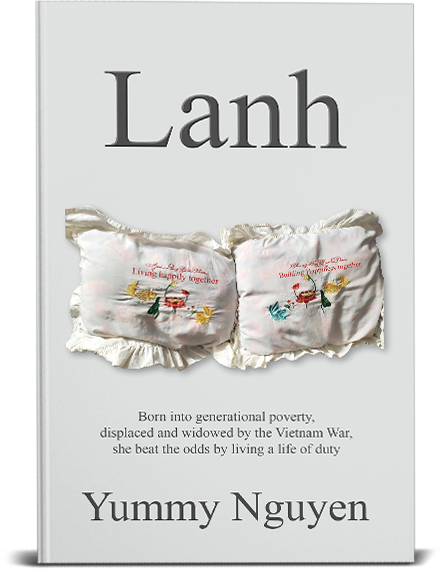
LànhA life remembered.
A son’s account of his mother’s journey through war, displacement, and the enduring pull of home.
 Vietnam / The Philippines / Germany / America
THE STORY
A life of duty.
A legacy of love.
Author, Yummy Nguyen, pens down a spellbinding tale of his mother as she spends her life as Vietnamese immigrant who lived through the Vietnam war, followed by two years of life as an immigrant in the camps in the Philippines. The story is an account of the struggle of the author’s mother as an immigrant parent and how she managed to keep herself and her children true to her Vietnamese roots while living in the Melting Pot.
This emotional rollercoaster invites readers to reflect on their own love for their country, making the story a powerful and resonant exploration of the immigrant experience and the enduring strength of cultural identity.

MEET THE AUTHOR
Yummy Nguyen
“I was born in communist Vietnam, grew up in socialist West Germany, but I’m going to die a capitalist in America.”
Read the author’s story +
When asked to describe himself briefly, he often responds with some form of, “I was born in communist Vietnam, grew up in socialist West Germany, but I’m going to die a capitalist in America.” Yummy Nguyen is no writer. He’ll tell you about that one time he was awarded $50 for “honorable mention” in a poetry contest that likely had but four submissions. While attending LSU A&M in Baton Rouge, LA, he’ll boast that he was best known for his Tetris® skills, a likely explanation as to why it took him five years to finish a 4-year degree plan. Up until medical school at USUHS in Bethesda, MD, he had a second life online as “Ramboette,” the night elf warrior and raid leader who tanked for a guild of professional engineers, pharmacists, educators, and a nurse to conquer Karazhan in World of Warcraft®.
While he still has delusions of past grandeur, he has settled into his day job, proudly serving in the United States Navy as an Aerospace and Family medicine physician.
INSIDE THE BOOK
The opening pages.
Eight chapters. Eight beginnings.
Step inside Lành’s story.
01Chapter 1: Dreams and Memories+
Opening-page excerpt · Page 1 · Continues on the next page.
For her, it was all she knew. It was her universe, a world she had been accustomed to since birth. If there was a haven she could call hers, it was that.
The month of January had been nothing short of a ride of recollections, the year she found herself traveling back to the older days, to days of her infancy, innocence, and youth. Was she proud of how far she had come? Perhaps only time could tell.
***
“Am I alive?” she asked herself doubtingly. No matter how hard she tried, the words couldn’t escape her mouth. She feared that her voice would reach anyone in the room. Could anyone hear her? She could not quite tell as she furthered, stepping into oblivion. The door to her childhood was a few steps away, and the illuminating pathway had tempted her heart enough to plunge into it.
“She’ll be fine; she’ll come to her senses soon,” said the attending physician. Lành paused briefly as the soft voice reached her ears. It was someone she could not recall ever meeting before.
“Doctor, thank you for meeting with me.” She smiled feebly; it was a familiar sound this time, “I understand she has been in the intensive care unit, sedated and intubated since yesterday. What do you think happened, and how is she doing?” her son asked. He just had arrived at DFW from LAX. He switched out with his sister as their mother’s bedside attendant. The COVID-19
02Chapter 2: A New Beginning+
Opening-page excerpt · Page 7
When Lành married, it was normal in her town to marry young. The idea of marrying before completing a primary education was not as foreign as it might be today. Vietnamese parents often wedded their beautiful daughters to men in possession of social status, wealth, and education. Men married women for their health and beauty, mostly beauty, however. The prettier the woman, the wealthier and the more handsome the man they married to secure a better lifestyle.
Her parents, too, found her a match at the tender age of fifteen when nothing but innocence awash her. Lành married at a time when she did not know what marriage meant. And because dating was not a cultural norm, she married a man she barely knew. “The first time I saw him was at his parents’ funeral. He was 17, and I was 14. He was crying. I doubt he even remembers that I was there. My parents attended the funeral at his parents’ home, and I happened to go with them.” She recalled meeting Cả for the first time as she saw her younger self watching him from afar. At the time, she did not feel emotionally connected to him.
She was too young to understand her emotions, even if she felt a connection. “Cả was mourning his parents, and none of us managed to talk that day. It wasn’t until weeks later that we met. I was carrying home bunches of bananas as part of my routine when he offered to help,” she remembered, smiling at how the two only giggled the first time they had an actual meeting. The two could not hold a proper conversation because doing so would break the social norms of the time.
03Chapter 3: Marriage and War+
Opening-page excerpt · Page 14 · Continues on the next page.
In 1966, fate had other plans for the young couple. They had no choice but to face the Vietnam War. Lành was too naïve to understand that it was a war. Lành thought that there were merely skirmishes between the opposing sides.
Until one day, her husband, Cả, was caught up in one of these skirmishes while he took the cows out to graze.
He got shot while he took cows out to graze, and as he bellowed – wounded and fallen to the ground – for the pain aggravated in a fleeting second, someone took him to the hospital. Once he recovered, they put him in jail, thinking of him as another spy.
On the other hand, Lành seemed to have zero clues about her husband’s whereabouts and waited for him like he would return any day.
***
It had only been a year since their marriage. Their relationship was still in its nascent stages, gradually developing as the two continued to learn more about each other when a calamity of such intense gravity struck them. Her husband went missing, leaving her alone with a baby in her womb.
She was pregnant with their son, and her marriage had seemingly come to an unfortunate end. She did not know where to find him or whom to go to help her carry out a search operation for her missing husband. She was young and naïve, with zero knowledge of how the world outside operated. Lest to
04Chapter 4: Survival+
Opening-page excerpt
Life in Buôn Mê Thuột was very different from village life. This was a big city with an airport, roads, and cars. There was a large southern Vietnamese military presence.
Lành’s second husband, Chật, enlisted there. Lành and her son initially moved into the enlisted military housing, which consisted of a room and a kitchen. Chật was gone most of the time.
Over the next three years, Lành continued to buy the daily catch from the local fisherman to sell at the market. Those nights of sleeping on the beach, she seemed distant now. She grew her business to the point where she hired her salespeople.
With her earnings, she bought a small house for her family. Phi, now a toddler, was taken care of by a young local girl whom Lành hired as a live-in sitter. Lành carried her family’s weight. She was never again financially dependent on Chật. His military pay was barely enough for his daily expenses. Lành paid for the childcare, food, and household expenses.
That timid teen had matured into a financially dependent businesswoman who made her own decisions.
One fine Fall day in 1974, Lành went to the market to sell seafood like every day. A neighborhood couple came telling her about a woman whose baby cried without stopping.
“Come Lành, there’s a newborn at the hospital who has not stopped crying since birth,” they cried, reaching for her.
“Wait! What’s going on, and what am I supposed to do?” Lành questioned while trying to run her business in the fish market.
05Chapter 5: Cả’s Return+
Opening-page excerpt · Page 28
Returning to Cồn Nhàn marked a return to a simpler, more tranquil existence for Lành. Her parents joyfully embraced their two grandchildren, Phi and Hùng, as Lành reveled in the comfort of family and small-town living. The bustling city life had never truly been her own.
She had never set foot on one despite glimpses of airports and planes. The roads between villages were sparsely populated, with only a handful of mopeds and even fewer automobiles.
Laws were unwritten, existing as social norms handed down through generations, and town elders settled disputes. Routine and predictability became Lành’s cherished companions.
Her younger siblings, too, found solace in this return to simplicity. The war had spared them, both as soldiers and victims. Reflecting on her past, Lành felt as if a lifetime had passed since her marriage to Cả, widowhood, and subsequent remarriage. Cả’s remaining family resided in a village just on the opposite side of town.
Lành and her family of four settled into a home within the village where her parents lived. The village and extended family provided a supportive social network.
Chật resumed his ancestral occupation as a fisherman, while Lành, with financial stability from prior savings, set up a smaller-scale business. Returning to her roots, she engaged in her expertise – buying low, transporting, and selling higher.
06Chapter 6: Leaving Vietnam+
Opening-page excerpt
Lành helped Cả settle into his new life as they moved into her parents’ home until they could afford a house to reside in. One day, while he was changing, she noticed a healed scar on his posterior right thigh. Curious, she asked, “What happened there?”
“This is where I was shot the day I took the cows grazing. They mistook me for a spy, giving away their position. The bullet went through this spot. Over the-” Cả answered, abruptly stopping mid-sentence.
Lành quickly transitioned, “Ready to go to your older sisters’ place?” She knew that those were memories that Cả was trying to suppress.
Poor Cả had frequent nightmares. All she could do now was help him put the pieces of his life back together. She bid him a safe travel as he left for his sister’s village to reclaim his inheritance.
***
Cả returned in the evening and handed Lành 60,000 Đồng. He appeared tired. Without even glancing at Lành, he let out a drawn-out disappointed sigh, saying, “This is all that is left.”
Lành was ecstatic and did not understand Cả’s disappointment.
“This is only a fraction of what my parents left me. My sisters sold the home and the land.”
07Chapter 7: A Difficult Decision+
Opening-page excerpt · Page 45
Lành’s family and all passengers were directed to a temporary camp where each family was given mosquito nets and tarps for temporary shelter. Lành and Cả decided to sell the boat to the Filipino fishermen.
She was glad to have received some money for the boat but sad knowing that the boat represented the last source of income for her and her family. Once again, she felt like she had to start over, but she felt more prepared this time than ever.
They stayed at the temporary refugee camp for only five days. The hardship Lành experienced was emotional rather than physical. There was no work to keep her busy. Planning for any future also felt impossible.
Lành spent her days in the tent caring for two boys while the men waited in line for food and fuel rations. The rations usually included some rice, salt, fish sauce, and pork. Kerosene was also handed out as a source of heat to cook with.
Survival requires cooperation and pooling of resources, such as cooking rice grain rations together to use the kerosene efficiently. This was where Lành’s life experience came into play, as she asked Cả to communicate the plan to the refugees in adjacent tents.
Naturally, everyone agreed to Lành’s cooking meals. Cả, of course, had no difficulty bringing in lone refugees who needed assistance. While she complained to Cả about his actions, she also had no heart for turning anyone away.
08Chapter 8: America+
Opening-page excerpt · Page 54
The family took a leap of faith, moving to America for the brighter future they wanted to pursue with their family.
This leap of faith was most difficult for Lành as she found a peaceful life with her husband and three children. While Cả talked about a limitless future, Lành was satisfied with her stable life in West Germany.
Even the thought of reuniting with her parents and siblings was not enough to convince her to uproot her family and move across another ocean. Lành agreed with Cả that her children deserved more opportunities, so she reluctantly agreed to venture into the unknown again.
(SUMMER, 1986)
Lành and her family landed in New York City, where her younger brother Hoàng promptly picked her family up by car. She was amazed by the size of American vehicles and driving lanes.
She wondered why everyone was driving so slowly, so she asked Cả. “The highways here have speed limits, about 100-110 kilometers per hour. It’s not like the autobahn in Germany. Also, they use miles per hour in America,” Cả explained. Lành was reassured, but not surprised, by Cả’s quick grasp of the American standard system.
“The kids are starting to get hungry. Did you pack any food?” Lành asked Hoàng.
STAY IN TOUCH
Every story begins
with a connection.
Contact the author about Lanh.
Visit the guestbook ↗